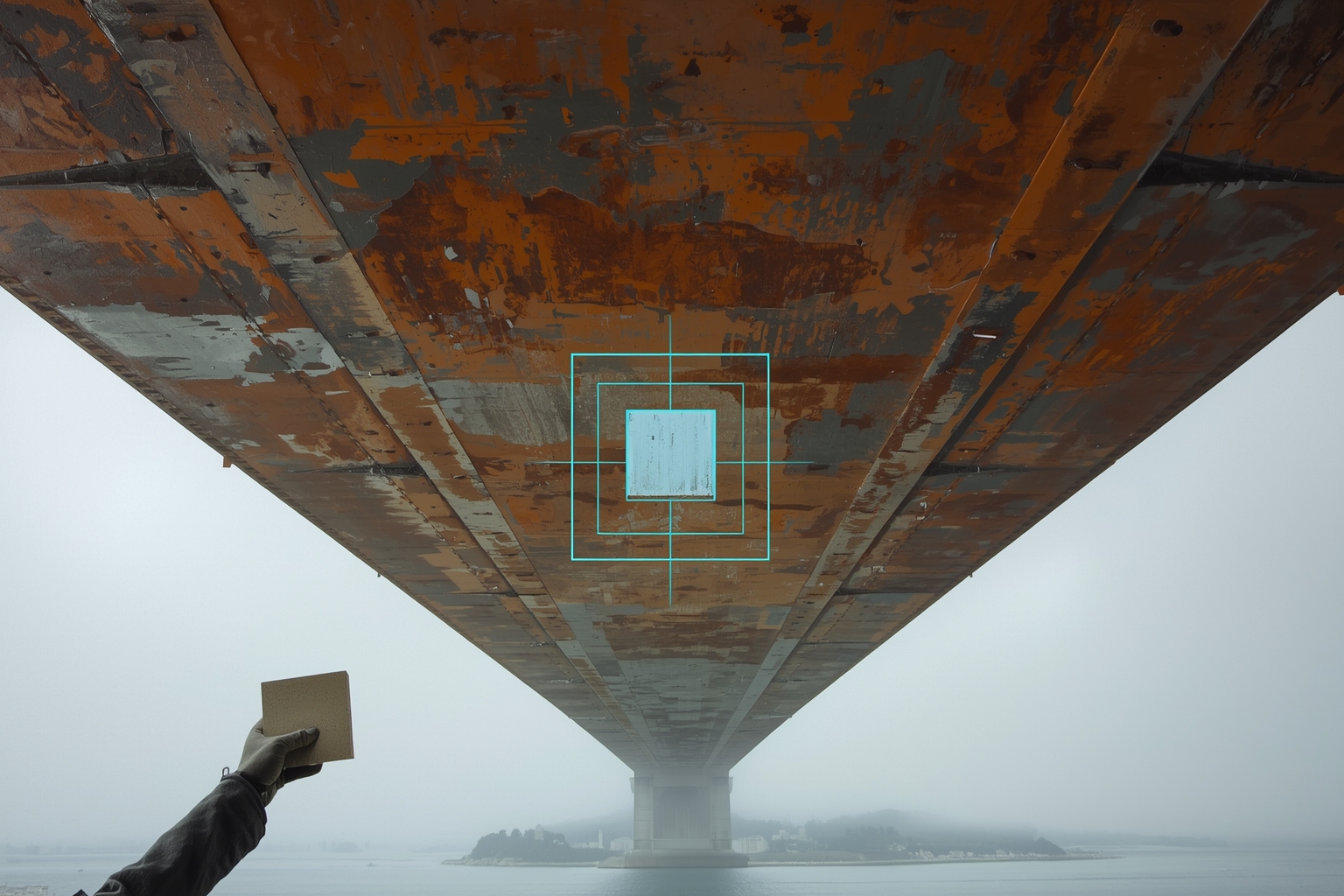
On Mina’s first day painting the bridge, the foreman gave her three rules.
Clip in twice.
Keep moving east.
Nothing but International Orange.
The bridge was longer than a person could understand from either shore. Up close it became bolts, seams, plates, and the bay sounding below. Mina learned it one arm’s reach at a time.
The crew worked east until the paint behind them began to fade, then returned west and started over. Nobody finished the bridge. Finishing was a word used by people who drove across it.
At lunch, the others climbed into the windbreak and unwrapped sandwiches. Mina stayed beneath the roadway. In her pocket she carried a sample jar of blue paint left from her kitchen ceiling. She dipped the wooden end of her brush and pressed a square no larger than her thumbnail onto the sheltered face of a crossbeam.
The next day, she painted another.
She did not place them at measured intervals. One marked the day a gull stole half her sandwich. One marked the morning the bay vanished into fog. One marked the call from her sister saying the biopsy was clean. When the first jar dried, Mina mixed another at the hardware store from the old number written on its lid.
The squares wandered east with the crew, a private procession hidden from drivers and nearly invisible even to the painters.
International Orange was the color of warning. Mina’s blue was the color of having been there.
Years passed. Foremen retired. Harnesses changed. The bridge acquired cameras that could see rust blooming beneath paint before a human eye could find it. Mina’s squares accumulated under the roadway, hundreds of small blue interruptions in the sanctioned color.
Then the maintenance authority bought a scanner.
It rode the bridge at night and compared every exposed inch against a perfect digital skin. On its first pass it found two hundred and ten coating defects that formed an improbable line eastward.
The new supervisor called Mina into a trailer and turned the monitor toward her. The bridge floated there as a gray model freckled with blue warnings.
“Contamination,” he said.
Mina looked at the points. She could remember many of them, though not all. Near Pier Four: the day a wrench fell and never seemed to strike water. Midspan: the afternoon every ship sounded its horn at once. The western tower: her sister’s second clean scan.
One square meant nothing to her. She enlarged it until the image broke into pixels. The date belonged to a year she remembered as difficult, but the square would not say why.
“You know anything about these?”
Mina said she did.
The supervisor was younger than the oldest square. He was not cruel. That made it worse. He explained adhesion, inspection ambiguity, the cost of false positives. Every visible blue mark would have to be sanded, sealed, and repainted.
“Nothing but International Orange,” he said, almost apologetically.
“There are two hundred and eleven,” Mina said.
The scanner had missed one inside a narrow gusset where two plates met. She had put it there on the day her sister died—not from the cancer they had watched for, but from an aneurysm neither of them had known to fear.
The supervisor added Mina’s coordinate to the work order.
For six weeks she erased herself.
She found each square from waterproof maps clipped to her harness. Some had kept their hard edges. Others had thinned until orange showed through like evening behind a curtain. She sanded the gull, the fog, the clean biopsy, the wrench that never struck water. She sanded the square whose meaning she had lost. The paint had remembered no more than she had.
She sealed them. She painted them orange.
At the last coordinate, Mina could see blue only by turning off her headlamp and letting reflected water move through the joint. The sanding tool would not fit. Removing the square required opening the gusset during the next structural overhaul.
The supervisor’s voice came over the radio. “Two-eleven?”
Mina held the brush. Bay light lifted the square, lost it, lifted it again.
“Deferred—access,” she said.
The phrase entered the maintenance system. A yellow triangle replaced the square on the model.
Years later, after Mina retired, ultrasound found a crack near that joint. The repair crew opened the gusset and an inspector named Luis found the blue square inside.
His work order contained the old note: FOREIGN COATING. REMOVE DURING ACCESS.
He photographed the mark beside a scale, tested the surrounding steel, and called Mina because her name remained attached to the deferred item. She answered on the fourth ring.
“You painted it?” he asked.
“Yes.”
“Does it mean something?”
There was a long silence. Wind struck his microphone. Far below, a horn moved through the fog.
“My sister died that day,” Mina said.
Luis looked from the blue square to the crack running past it. The paint had neither caused the fracture nor prevented it. The repair would cut through both.
“I have to remove it.”
“I know.”
He expected her to ask for another photograph. Instead she asked whether the bridge would be safe.
“Yes.”
“Then do the work.”
Luis uploaded the photograph to the inspection record. In the notes, beneath coating condition and crack length, he added a field the form had not requested:
KNOWN HUMAN MARK. MEANING RECORDED BEFORE REMOVAL.
Then he ground the blue square away.
The repair held. The digital model returned to gray. Nothing of Mina’s sister remained in the gusset—not the paint, not a trace a future scanner could find.
But Luis kept adding the field.
Most defects meant nothing beyond salt, age, impact, and weather. Some held initials, dates, measurements, jokes, warnings in obsolete notation. He recorded them before the work erased them. Other inspectors began doing the same, first by copying his reports and then because the software team made the field official.
Years after Mina’s square was gone, a new painter found a chalk arrow beneath the eastern tower. The arrow pointed nowhere the current plans recognized.
She photographed it before washing the plate clean.
On the form she selected HUMAN MARK and wrote what an old rigger told her: once, before the radios worked in fog, the arrow showed which way to crawl home.